
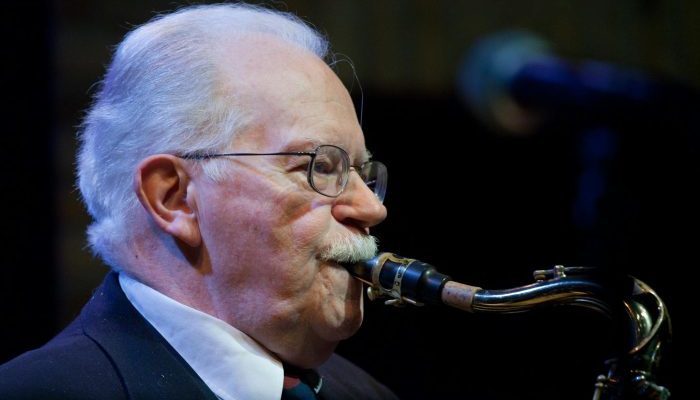
PHOTO: Andrea Canter
Dave Karr, dean of Minnesota saxophonists, dies at 95
Known for his masterful playing, wit and generosity, he influenced generations of musicians over his long career: “He raised the bar and made us all better musicians.”
By Jon Bream
The Minnesota Star Tribune
When it came to music, Dave Karr was serious and creative, the top tenor saxophonist in the Twin Cities for decades. But between songs or offstage, Karr was a real cutup.
“He was almost like a vaudeville guy,” said jazz bassist Gordy Johnson, a colleague of 35 years. “He would sit at the piano all of a sudden and play his rendition of Chopin’s ‘Minute Waltz’ in 4/4 with a boogie-woogie feel, and everybody would just be cracking up.”
Karr, the dean of Twin Cities saxophonists, died July 19 at his home in St. Louis Park of natural causes. He was 95.
“Dave was everybody’s favorite tenor player, and he was a wonderful flutist,” said Pete Whitman, a fellow saxophonist/flutist/clarinetist. “He played beautiful ideas. He had such a great swinging sound and tone. He blew everybody away that played with him.”
“Dave always knew exactly what to play and everything he played was appropriate for the situation,” said jazz vocalist Connie Evingson, who enlisted Karr on countless gigs and on all 10 of her albums (including the upcoming “Hornucopia”). “He wasn’t always playing safe; Dave would take risks. He raised the bar and made us all better musicians as a result.”
He played his last gig in March 2020, with Evingson, just before the COVID-19 pandemic. Karr continued to play his sax at home for four years, with drummer Joe Pulice sometimes accompanying him.
Karr was born in Canada and as a child moved to England, where his father, saxophonist Harry Karr, got a gig with the BBC in London. The family relocated to New York City when Dave was about 9.
Dave took up the saxophone after hearing a Stan Kenton recording featuring tenor saxophonist Vido Musso. As a teenager, he hung out on Manhattan’s music-centric 52nd Street, experiencing such jazz stars as Charlie Parker and Dizzy Gillespie as well as a young Sonny Rollins. After high school, Dave Karr joined the Sonny Durham Orchestra followed by a stint in the 324th Army Band based in Aberdeen, Md., during the Korean War. He auditioned by playing piccolo.
Karr later studied at the Manhattan School of Music and, after a visit with relatives in Minnesota, the University of Minnesota in the mid-1950s.
He had a multifaceted music career that included being a staff musician at the newly opened Guthrie Theater in the 1960s and a composer/producer/arranger of advertising jingles, winning a Clio Award in 1986.
Throughout his career, he performed with numerous bands, orchestras, touring Broadway shows and countless recording sessions. He was a member of regular ensembles including Jules Herman Orchestra, Ray Komische Orchestra, JazzMN Orchestra, Adi Yeshaya Orchestra, Whitman’s X-tet and his own Mulligan’s Stew.
“He was organized and friendly,” bassist Johnson said of Karr as a bandleader. “Whenever Dave was there, we had fun. His sense of humor was always ready to go. He was so clever and funny.”
Drummer Pulice, who worked with Karr for 45 years, described him as a “total introvert” who was serious about music but not a fan of the music business.
“He was the consummate musician, jazz and classical, knew most any tune that was called,” Pulice said. “He was very creative and very bright. One word I use is he was always curious. He could take things apart and he could fix anything. At 90, he was working on new stuff.”
Karr never really had a day job unless one considers his stint writing jingles and repairing instruments, said his daughter Jenny Oxborough.
“He was always funny, especially with his grandchildren,” Oxborough said. “He loved to make them laugh. He was comedic; he would do pratfalls. He was just great to have around.”
With their mother Diedra having a theater background and Dad as a musician, all five of the Karr children ended up in the arts, Oxborough said.
She was an admirer of her father’s musical abilities.
“Every solo he played was fresh and it always felt brand new for the moment,” she said.
In the jazz tradition, Karr was a sharp dresser, always in a black suit. But when he sat down to show off the crease in his trousers, he’d reveal unexpected red socks.
“It was like his way of saying: ‘I’m not going to completely conform,’” Whitman said. “That also went well with his sense of humor.”
Survivors include Karr’s wife, Diedra, and children Victoria Karr, Stephanie Karr Smith, Jenny Oxborough, Andrew Karr and Jeffrey Karr as well as eight grandchildren and three great-grandchildren.
A celebration of life will be held at the Dakota in the fall.